Platform
How Datamonk reads, fixes and delivers imaging data
A technical overview of the pipeline: what gets analyzed, how fixes are decided, who approves them, and how data is deployed and protected.
Predictable results, not black-box AI
Five principles govern every correction the platform makes.
Deterministic first
Most studies resolve against curated medical knowledge: known procedures, naming conventions and codes. AI is used only where certainty runs out.
Edge cases in full context
The hard studies are analyzed with everything available: all metadata across the hierarchy, cross-field consistency, and clinical context. From imports labeled "outside study" to copy-paste mistakes repeated across an archive.
Multilingual by design
Metadata is read across languages, vendors, abbreviations and local naming habits. One engine for every archive.
The image is the ground truth
Proposed fixes are checked against the pixel data itself: body part, laterality, contrast.
Clinical teams in control
Edge cases are grouped for clinical review. Approved fixes run automatically, every change is logged, and every learning makes the next study easier.
From input tokens to clinical context
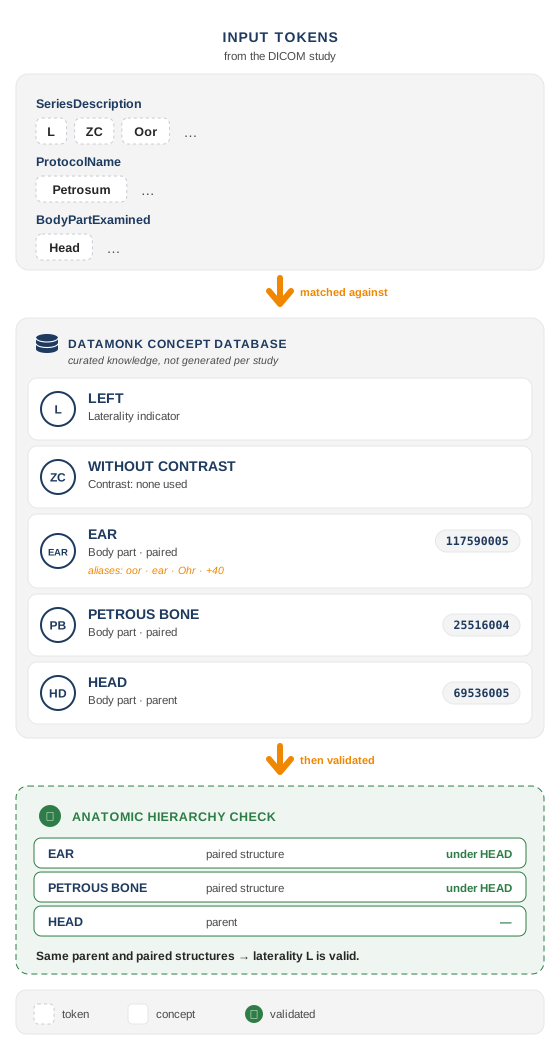
Metadata isn't corrected field by field. Tokens from across the DICOM hierarchy are mapped to standardized concepts, then validated against each other — laterality against paired structures, body parts against their anatomic parents, protocol against modality.

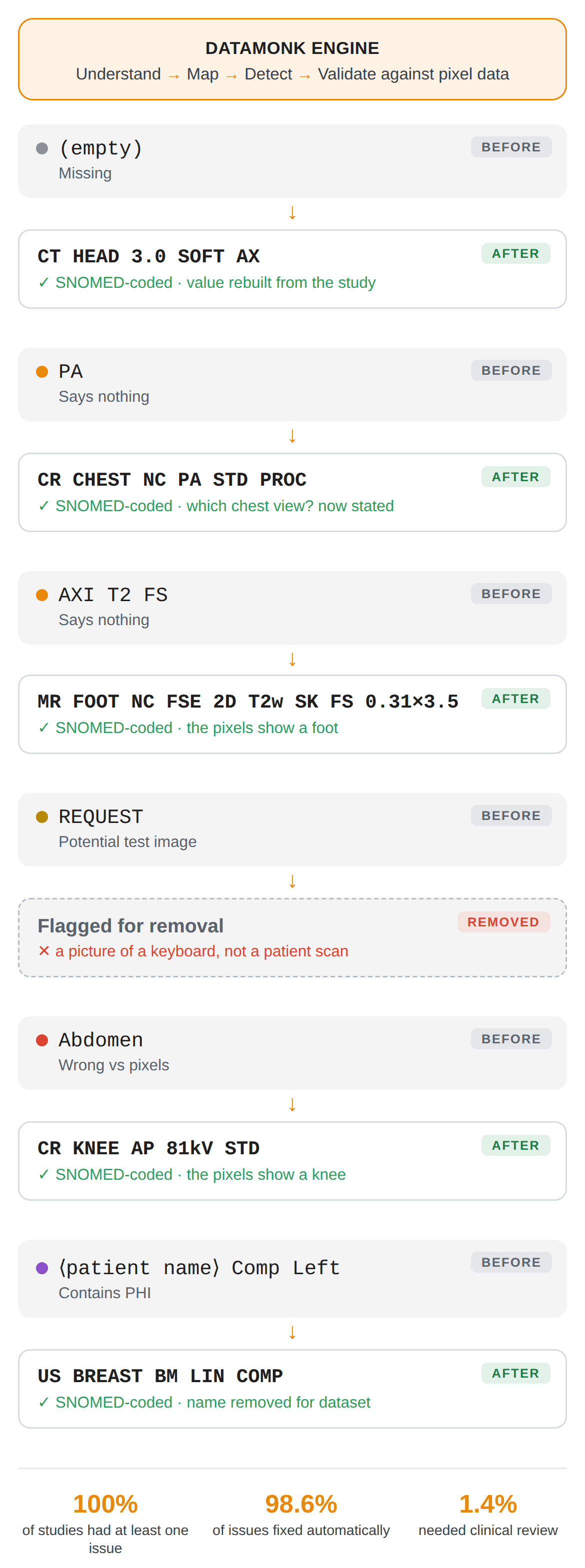
Before and after, on real archive data

Coverage across the DICOM hierarchy
100+ tags analyzed per study, at every level:
PATIENT
Patient ID
Name
Sex
and more
STUDY
Study Description
Procedure Code
Accession No.
and more
SERIES
Series Description
Body Part Examined
Laterality
and more
IMAGE
Anatomic Region
Modality
Contrast
and more
Output is normalized and SNOMED CT-coded, de-duplicated, and validated — delivered to any target: new PACS, cloud archive, VNA, or research environment.

Deployment and security
Test it on your own archive
Start small: a Data Quality Report analyzes 10,000 studies from your archive — any modality, any vendor — and delivers findings with sample corrected files, in 4–6 weeks. It begins with a 30-minute intro call.